
Tips for tasks
The tips below are not specific to Todo2d. They work with any system. If you are looking for arguments to use, Todo2d, we recommend our main website: https://www.todo2d.com
Make it an action
Section titled “Make it an action”A well-crafted task includes a verb, such as “write”, “create”, or “change”. Placing the verb at the beginning allows for clear communication and makes it easier to verify progress. This is because emphasises lies on the action and the completion of the action.
For example, asking did you write the report?
is more effective than
asking what the status is.
When unsure how to phrase a task, using “ensure” as a starting point can be helpful.
This approach is handy for complex tasks that involve multiple steps. Instead
of trying to encapsulate everything into one task, break it down or use
ensure [desired outcome]
, such as ensure sales targets are met
.
Keep it Focused
Section titled “Keep it Focused”Tasks should be manageable chunks of work that you can complete within a short
time frame (minutes to a few hours) without interruptions. If a task is too
broad or likely to be interrupted, consider splitting it into smaller, more
focused tasks. For instance, instead of having a single task like write the
documentation
, break it down into individual tasks for each page or
section. This approach ensures that each task remains simple and achievable.
Don’t waste time
Section titled “Don’t waste time”Your time is a limited resource and is, therefore, incredibly valuable. So, don’t waste your time on tasks you can’t complete.
- Focus on what you can do now if that task is straightforward.
- Hide tasks that you can’t perform at this very moment (this is a feature of Todo2d).
- Delete or hide tasks that you are dragging along. If a task hasn’t started in the last two months, it likely won’t start anytime soon.
- Remove tasks you are unsure about or need to make a decision on.
- Or replace them with
Make a decision…
style tasks.
- Or replace them with
The idea is that you ensure you focus on the tasks that provide you some kind of value.
Connect Your Tasks
Section titled “Connect Your Tasks”To maximize productivity and efficiency, connect your tasks in a logical sequence. This means identifying which tasks are dependent on the completion of others and ordering them accordingly. For example, when planning an event, you would typically:
- Set a date for the event
- Send out invitations to guests, but only after setting a date
- Determine a menu, but only after setting a date
- Process the responses, but only after you send the invites
- Create a shopping list, but only after you processed the responses and have determined a menu, you don’t want to buy the incorrect amount or the wrong ingredients for the menu
- Buy ingredients, but only after creating a shopping list
- Prepare food, but only after buying the ingredients
- Enjoy the party, which you should seeing you have done all the hard work!
By connecting your tasks in this way, you ensure that each task builds upon the previous one, reducing errors and saving time. This approach helps you stay organized and focused and achieve your goals more efficiently.
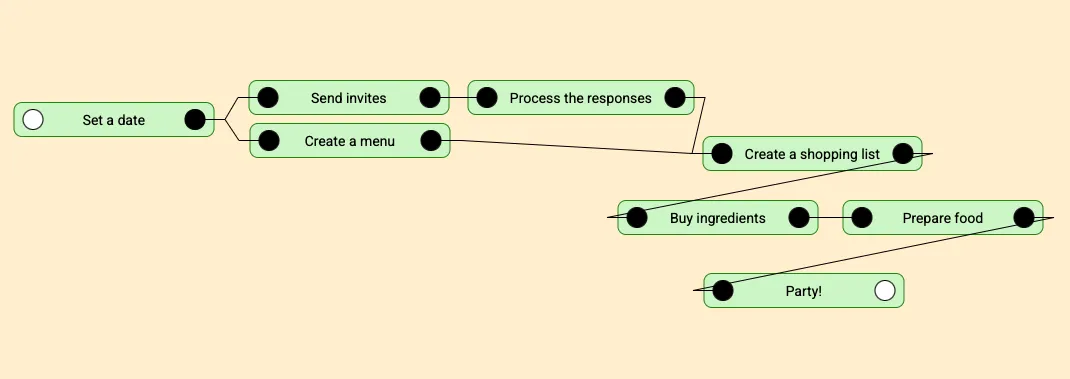
There is no sense in writing down a shopping list until you know how many people will show up and what you want to feed them!